Longevity intelligence · Australia
Blood tests show the numbers.
Vector shows the pattern.
Vector reads the Australian pathology reports you already have, tracks 102 biomarkers in the units your laboratory prints, and shows you which way they are moving.
- Free to start
- 102 biomarkers
- Australian report units
- Health data is never for sale

Worked example
What Vector found in Alex's last report.
Alex’s latest pathology report showed strong results and a handful of borderline signals. Vector connected the iron and red-cell pattern with B vitamins, recovery, fitness and inherited risk — then attached every conclusion to a reading and date.
Alex Adams · illustrative
Collected 27 June 2026
Ferritin
34µg/LFerritin: 34 µg/L. Vector range 30 to 200 µg/L. Inside the interval.
Transferrin Saturation
13%Transferrin Saturation: 13 %. Vector range 15 to 45 %. Inside the interval, worth watching.
Homocysteine
16.0µmol/LHomocysteine: 16.0 µmol/L. Vector range 5 to 12 µmol/L. Outside the interval.
Lipoprotein(a)
125nmol/LLipoprotein(a): 125 nmol/L. Vector range 0 to 75 nmol/L. Outside the interval.
Read together
Vector ranges shown. No source-laboratory interval is implied.
Illustrative Vector Profile. Alex Adams is a fictional person and all data are synthetic.
The cheaper way in
You don't need a membership. You need your results, organised.
Longevity programs bundle testing, imaging and clinical time into one annual fee. Most Australians have already had the bloods through their GP, and already have a doctor who knows them. What is missing is the part that holds those results together — and that part starts at nothing.
Compare with a longevity clinic- Track your own reports
- $0
- Vector Premium
- $9.99/month
- Need new bloods?
- $99one-off
All 102 biomarkers, your full history, no trial clock.
The Vector Profile, the projection and the full Plan.
An optional Australian panel. Never required to use Vector.
The real economics
The blood test was never the expensive part. The conversation was.
A longevity program's fee mostly buys you a doctor who will sit down and read your bloods to you. In Australia that conversation is already available, and for most people it is already free — what is missing is someone doing the reading beforehand. That is the job Vector does.
See the report you take in- Australian GP visits bulk billed
- 81.4%
- What Vector charges to find the patterns
- $9.99/month
- What the appointment then costs you
- $0*
Nationwide, across the three months from 1 November 2025.
Or nothing at all, if you only want the tracked record.
*At a bulk-billing practice. 3,700+ are registered.
Bulk billing figures: Department of Health, Disability and Ageing.
From report to record
One report is a snapshot. Vector makes it a series.
Most people collect PDFs in an inbox and compare them from memory. Vector reads the report, hands the values back to you to check, then keeps them in one place so the next one has something to be compared against.
Bring in what you already have
The app reads a PDF, scan or photo of an Australian pathology report and pulls out the values, units and collection date. If the file is on a computer, the secure handoff sends it across without signing in on that machine.
Check it before it is saved
Extraction gets a review step, not a rubber stamp. Every value, unit and date is editable, and nothing joins your record until you accept it.
Watch the direction
Once there is more than one report, each marker has a trend, body systems have a shape, and the biological age estimate has a direction rather than a single figure.
The Longevity Vector
A number tells you where you are. A vector tells you where you're headed.
Vector estimates biological age from your blood markers, then reads it against your chronological age over successive reports. The distance between those two lines — and which way it is moving — is the thing worth following.
How biological age tracking works- Reports in this record
- 8
- Latest estimate
- 29.9years
- Chronological
- 32.8years
- Longevity Vector
- -2.9years
Alex is younger overall while emerging iron, recovery and inherited-risk patterns still deserve attention. Longevity Vector is biological age minus chronological age, not a person’s “true age”. Illustrative Vector Profile. Alex Adams is a fictional person and all data are synthetic.
Read the methodology102 biomarkers
The library underneath the headline.
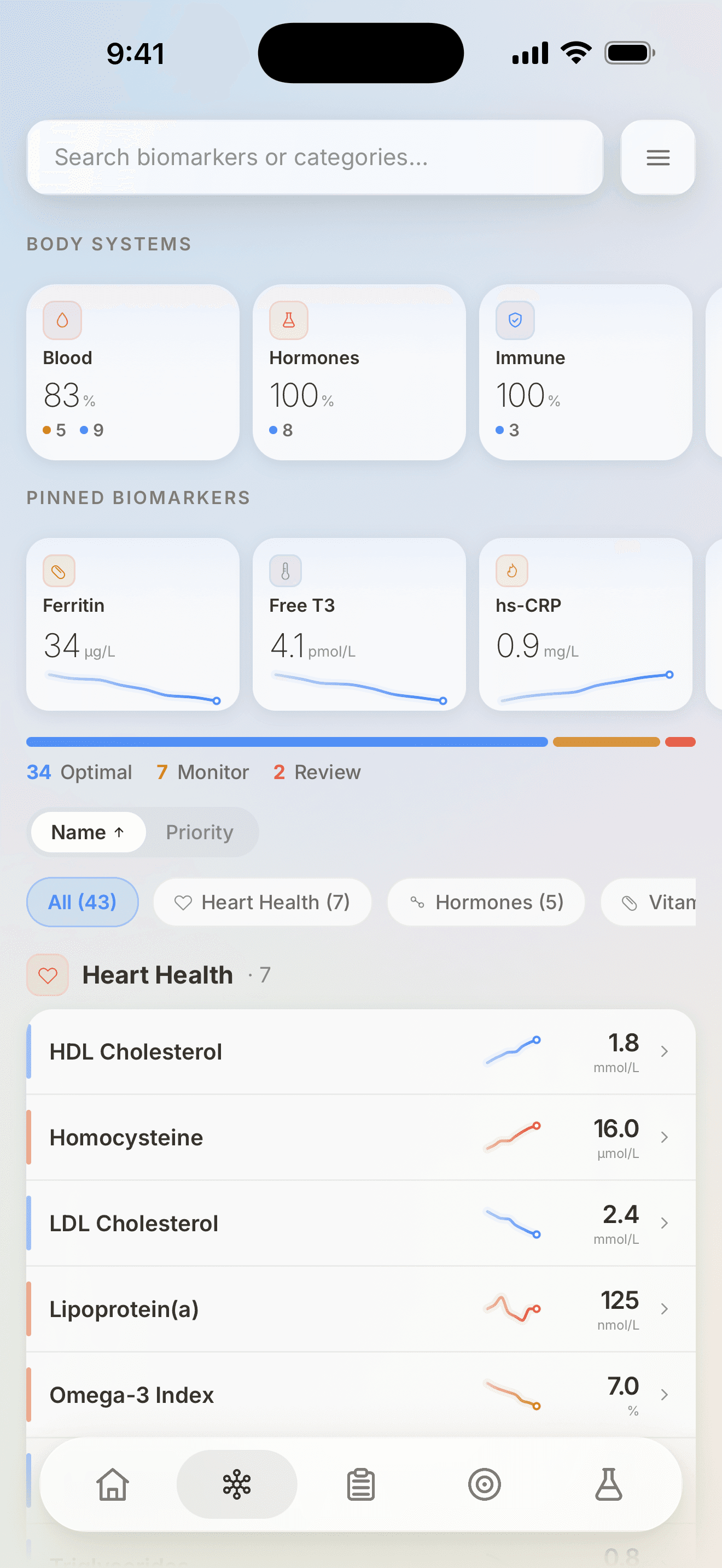
Every marker Vector can track has a page: what it measures, the unit Australian laboratories print it in, what can move it, and which results are worth reading beside it.
Browse the biomarker library12 markers
Heart Health
Lipids, particles and related markers that help you follow cardiovascular context over time.
Explore heart health5 markers
Blood Sugar
Markers of glucose regulation and the insulin response, shown in Australian units.
Explore blood sugar16 markers
Hormones
Sex, adrenal and growth hormones whose interpretation depends on timing and personal context.
Explore hormones5 markers
Thyroid
Thyroid hormones and antibodies that are interpreted together rather than in isolation.
Explore thyroid9 markers
Inflammation
Immune and clotting signals that can change with illness, training and recovery.
Explore inflammation16 markers
Full Blood Count
Red-cell, white-cell and platelet measures from a full blood count.
Explore full blood countVector Premium
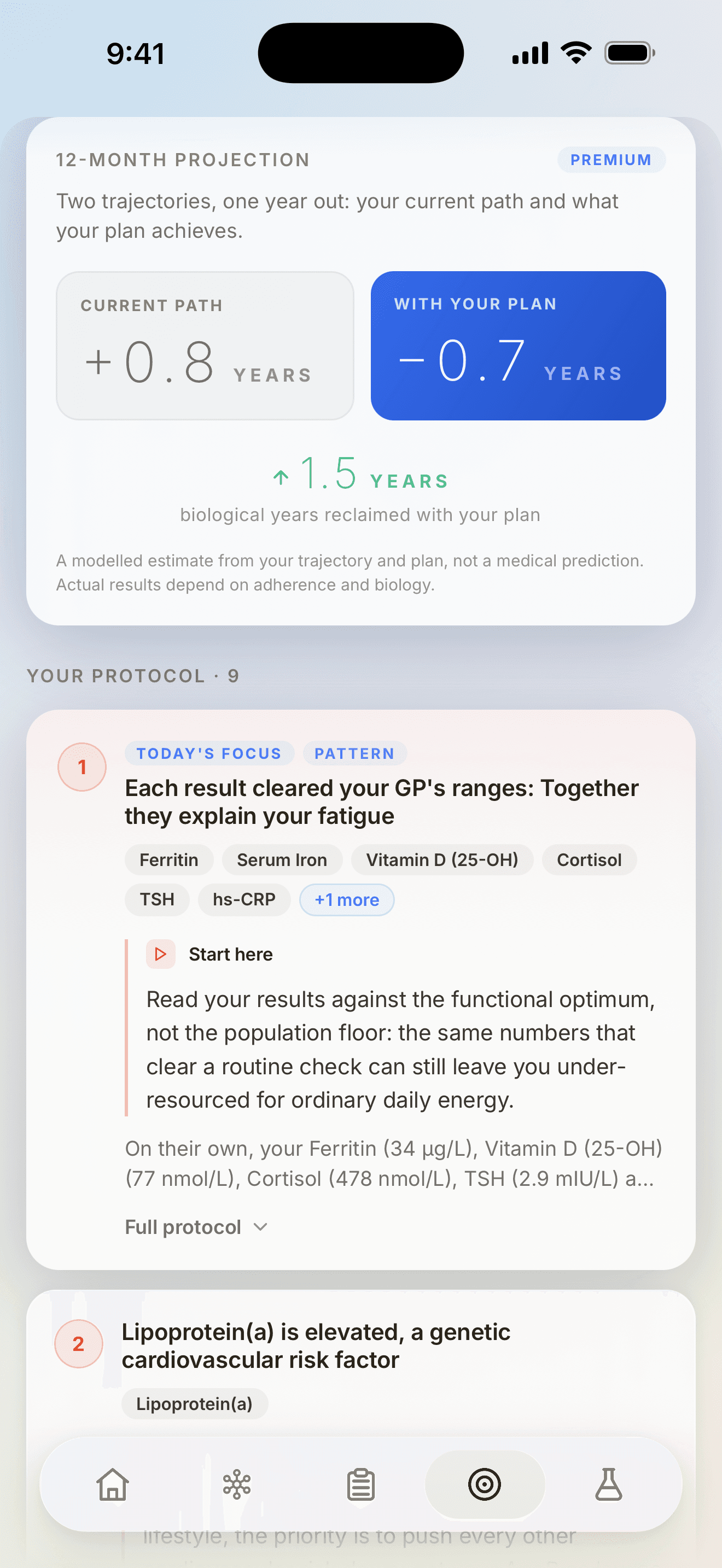
Two paths, twelve months out.
Premium models where your record goes if nothing changes, and where it goes if you follow the plan Vector builds from it. The gap between them is the part you control.
See what Premium includes- Continuing as you are
- +0.8years
- Following your plan
- −0.7years
- Modelled difference
- 1.5years
How it is modelled
Projected from your own trajectory and the plan Vector builds from it. What actually happens depends on adherence and on biology.
Premium is 9.99 AUD a month or 79.99 AUD a year. The record itself is free.
Take it to your doctor
9 pages of evidence, organised for one focused conversation.
Premium exports the Vector Profile as an A4 landscape PDF: evidence-attached interpretation, what changed and when, health-metric charts, complete biomarker tables, record coverage and up to six focused questions for your doctor.
Read Alex's case study- Findings first, then the complete measured record underneath.
- Every claim tied to a reading and a collection date.
- States its own coverage, so a thin record looks thin.
- Open the Alex sample profile — ungated.
- Biological age
- 29.9 years
- Chronological age
- 32.8 years
- Longevity Vector
- -2.9 years
What Vector noticed
No single result explained the fatigue. Vector connected the pattern.
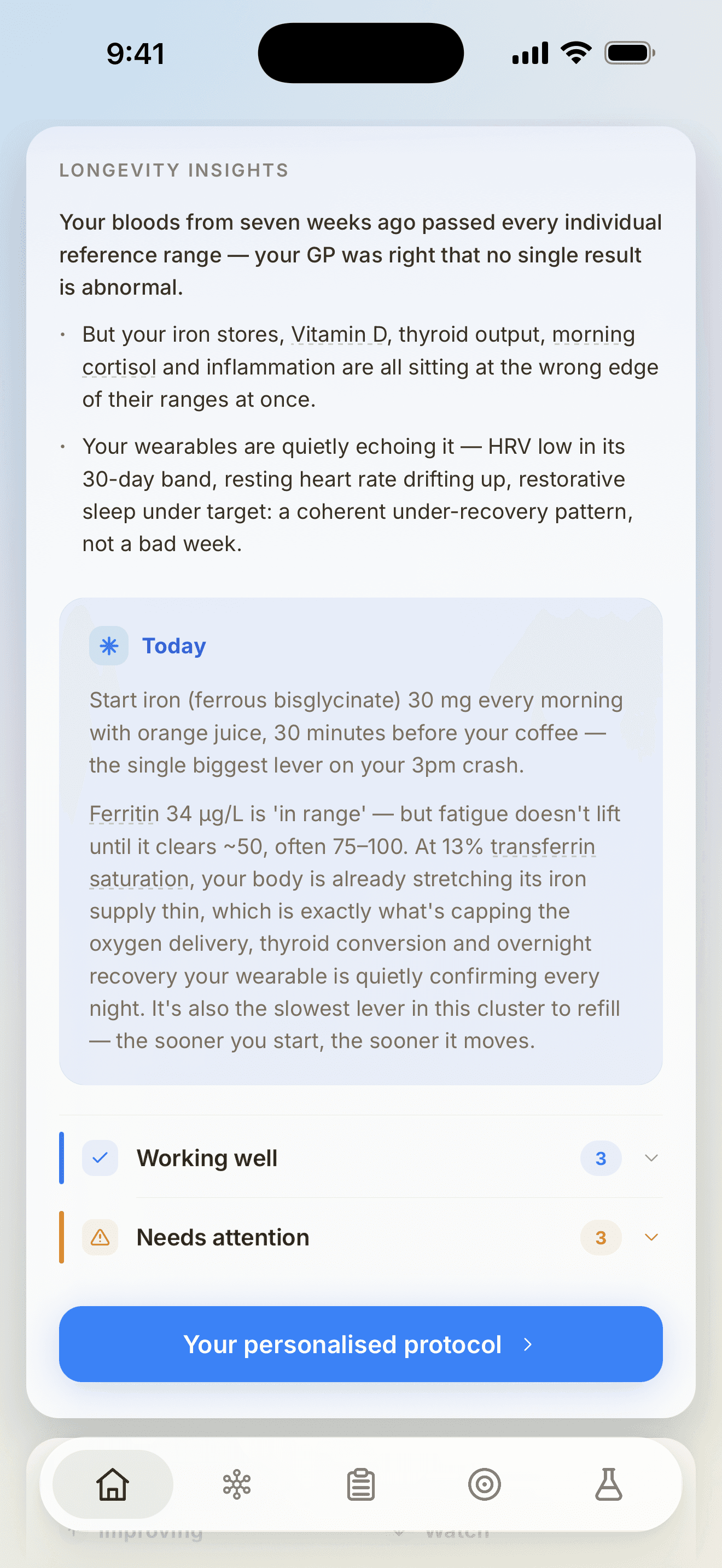
Ferritin and Transferrin Saturation were moving down as red-cell indices changed, while HRV, restorative sleep and aerobic fitness showed the same under-recovery direction. No single value supplies a diagnosis; the value is the connected, dated pattern.
- Ferritin · 27 Jun34µg/L
- Transferrin Saturation · 27 Jun13%
- HRV · 15 Aug42ms
- Restorative sleep · 15 Aug1.8hours
Questions for your doctor
- Haemoglobin is still normal at 122 g/L, but Ferritin is 34 µg/L, Transferrin Saturation 13%, MCV 81 fL and RDW 14.4%. Could this represent iron-restricted red-cell production before anaemia, and what would you investigate to establish the cause?
- Homocysteine is 16.0 µmol/L while Folate is 6.5 nmol/L and Vitamin B12 240 pmol/L. Should these be investigated as one B-vitamin supply or absorption issue, and what would you confirm before deciding how to correct it?
In the app
Built for the report you actually received.
Australian units, the labels your laboratory prints, and the collection date kept beside every value.
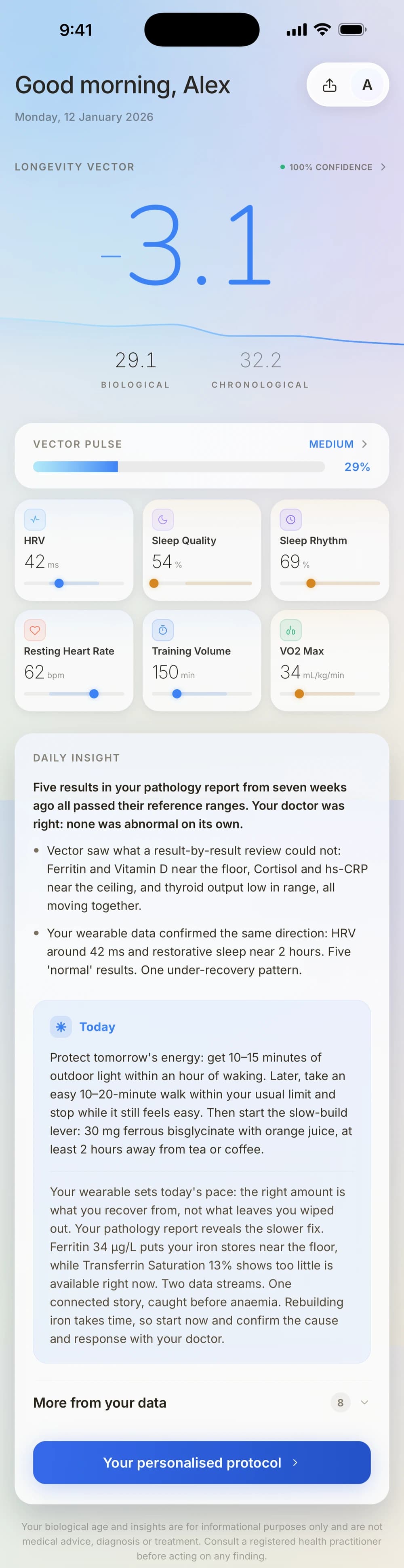
Explore the product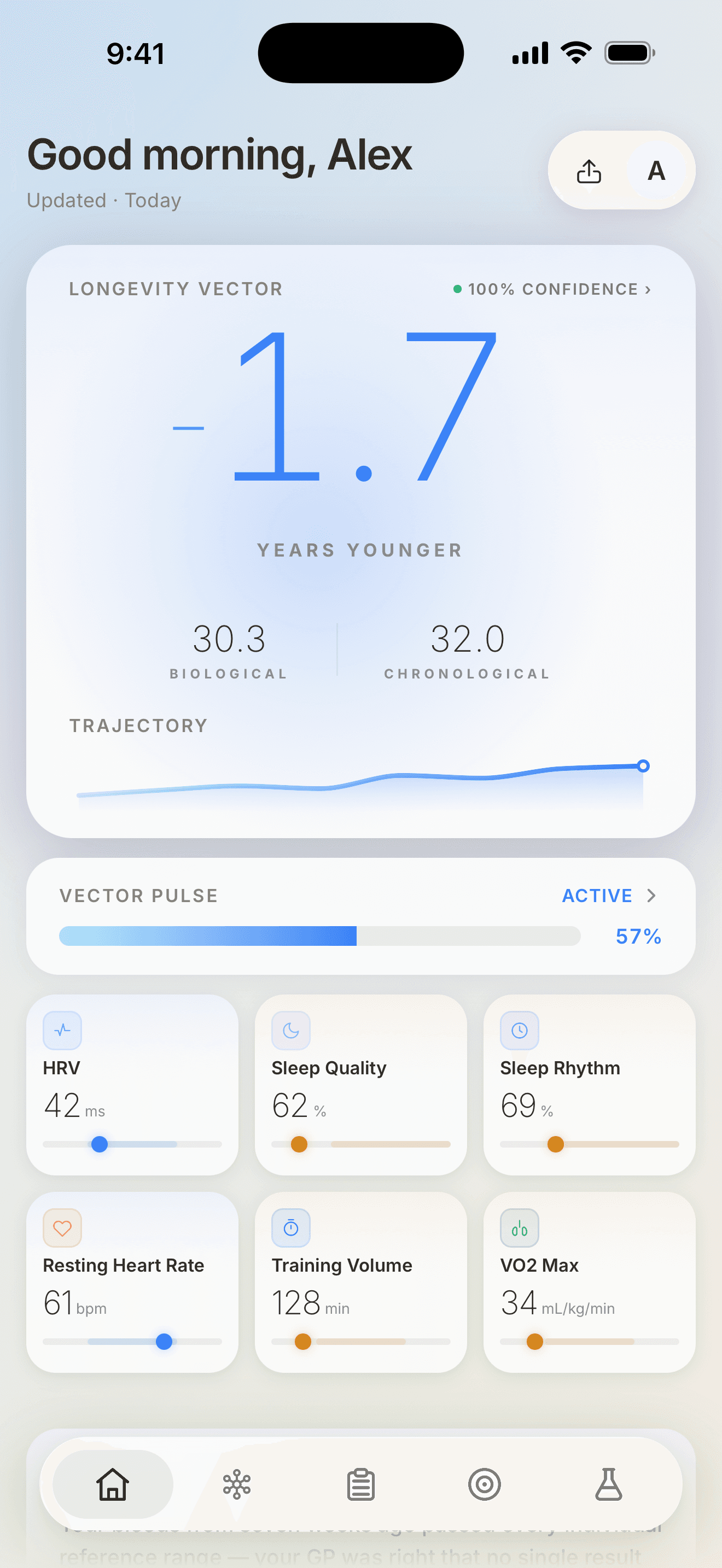
Privacy
Health data, held like health data.
Your health data is yours. Vector never sells it or uses it for advertising. High-granularity sleep and workout data stays on your device, and the website never parses a report. Files handed over from a computer go straight to your own account for the app to process.
How Vector handles your data- Health information is never sold or used for advertising.
- Reports are stored in a private, per-account bucket.
- Source files are cleaned up once results are saved.
- You review every extracted value before it is kept.
Questions
Answers, before you download.
Each answer opens by resolving its own question.
What does Vector do with a pathology report?
Vector reads the report and turns it into tracked results. The app extracts each supported marker with its value, unit and collection date from a PDF, scan or photo, shows you an editable review, and saves only what you accept. From then on that marker has a history rather than a single reading.
Do I need a new blood test to start?
No. Vector is built for the reports you already have, and a single past report is enough to begin. Adding older reports gives the record more history immediately, and each new one adds a dated point to it.
Does Vector work with Australian pathology reports?
Yes — Australian reports are what Vector is built for. It keeps the units Australian laboratories print, such as mmol/L for cholesterol and nmol/L for vitamin D, and uses the marker names that appear on local reports rather than converting them to overseas conventions.
How does Vector estimate biological age?
Vector estimates biological age from your blood markers using a published, peer-reviewed foundation, then standardises the result against an age- and sex-matched population so the figure is not skewed for younger adults. The estimate is shown with a confidence level reflecting how much of your data it had, and the direction it moves across reports matters more than any single value.
Is Vector a diagnosis, or medical advice?
No. Vector provides evidence-attached interpretation of the measured record: it tracks supported markers, connects dated patterns and shows the readings behind each finding. It does not diagnose, add an unmeasured cause or replace a doctor’s clinical interpretation, and the Vector Profile is designed to make that conversation more focused.
What does Vector cost?
The record is free. Importing reports, tracking all 102 biomarkers, browsing body systems and following your history cost nothing. Vector Premium is 9.99 AUD a month or 79.99 AUD a year (prices checked 2 August 2026) and adds the Vector Profile, the twelve-month projection, the full personalised Plan and daily AI synthesis. Optional Australian pathology panels are priced separately from the subscription.
Do I need an Apple Watch?
No. Apple Health data is optional context, not a requirement. If you do connect it, Vector reads signals such as resting heart rate, heart rate variability and sleep to fill the gaps between reports; without it, the record runs on your pathology results alone.
What happens to my health data?
It stays in your account and is never sold or used for advertising. Vector uses health information only to provide the features you choose. High-granularity sleep and workout data stays on your device, and report files are held in private per-account storage and cleaned up once their results are saved. Limited campaign measurement is kept separate from health information, pathology reports, biomarker values, names and contact details.
Start with the bloods you have already paid for.
Importing your reports and tracking all 102 biomarkers is free. Decide about Premium once your record has something in it worth projecting.